.svg)




The year is 2026 andOpenAI has announced it plans to start testing ads in ChatGPT in the US, initially for logged-in adult users on the Free and Go tiers. Ads won’t show for Plus, Pro, Business, Enterprise, or Edu accounts.
If you’re a marketer, this is one of those “don’t panic, but also don’t nap” moments.
Because the headline isn’t “new ad placement”. The headline is: a conversational interface is becoming a paid discovery surface, and that changes how you think about intent, creative, targeting, and measurement.
Here are the key takeaways from OpenAI’s announcement, in plain marketing speak, plus what you can do now to be ready to test this channel properly from day one.
What OpenAI has actually said:
OpenAI’s post is pretty explicit about how they want ads to behave inside ChatGPT, largely because the risk is obvious: people use ChatGPT for personal, important tasks, and trust is a key factor.
Here are the key points that matter for you as a marketer:
1) Ads won’t influence answers
OpenAI says ads will be separate and clearly labelled, and that answers are optimised for usefulness, not advertising. So: you’re not “buying the answer”. You’re buying a spot near it.
Marketing implication: this won’t behave like SEO (where you shape what ranks) or like classic paid search (where the ad is the primary result). Your ad is adjacent to an answer that may already satisfy the user.
So your creative has to earn the click in a world where the user might not need to click.
2) Conversation privacy + chat data
OpenAI says conversations remain private from advertisers, and it won’t sell your data to advertisers.
Marketing implication: expect contextual relevance to matter more than behavioural “follow them around the internet” targeting (at least early on). Think: “based on the current conversation” rather than “based on their last 90 days of browsing”.
3) Users will get control
OpenAI says people will be able to turn off personalisation, dismiss ads, and see why they’re seeing one.
Marketing implication: your ads will be in a higher-accountability environment. If your ad is irrelevant, people won’t just ignore it, they’ll actively tell the platform it’s irrelevant. That feedback loop will matter.
4) Early format: bottom-of-answer sponsored listings
OpenAI says the initial test is likely ads at the bottom of answers, when there’s a relevant sponsored product/service, clearly separated from organic output.
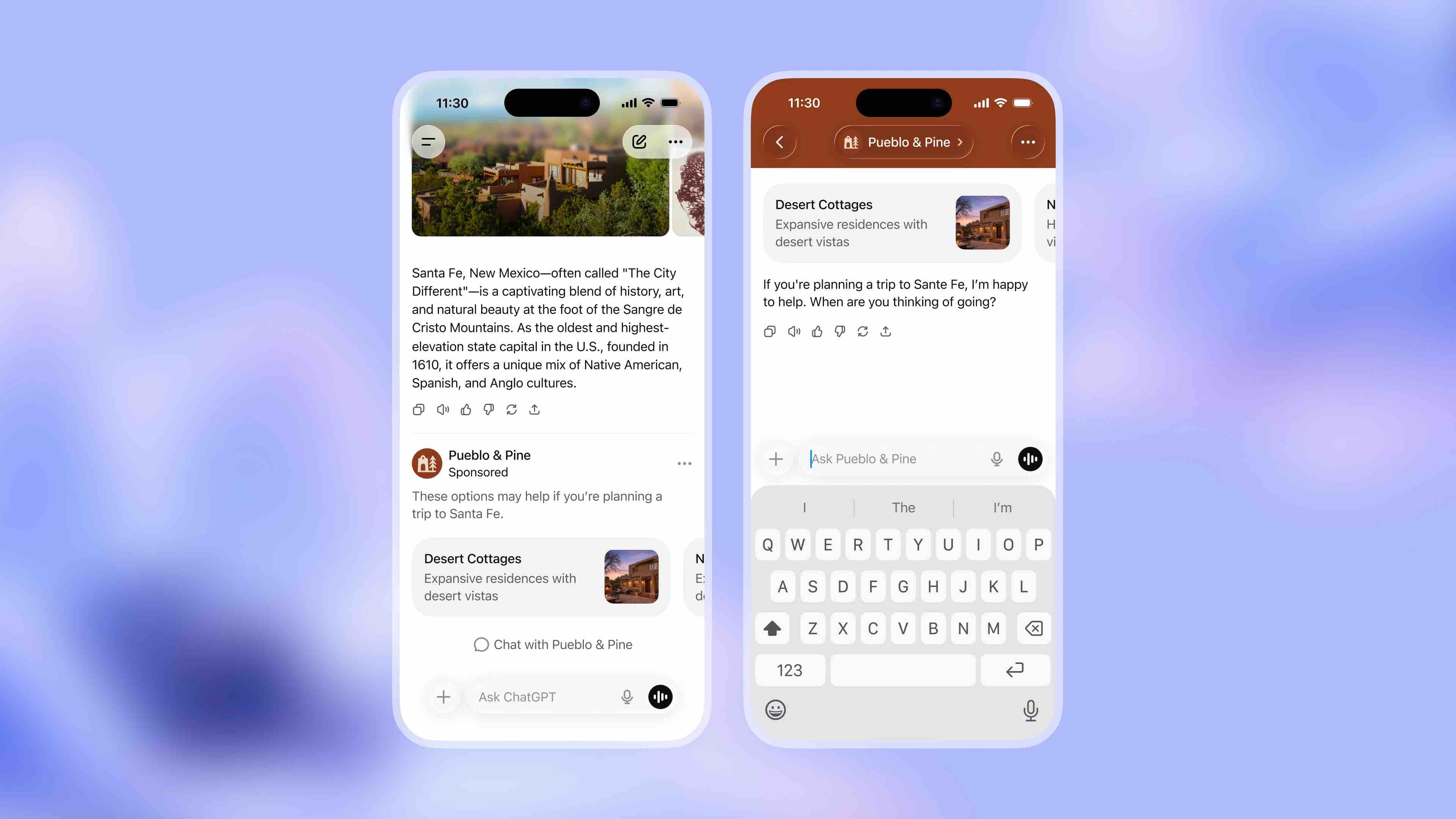
Marketing implication: this looks closer to high-intent product/service discovery than broad awareness placements. It’s not “interruptive social”. It’s “I’m already in decision mode, show me an option”.
5) Guardrails: adults only (for test) + no sensitive/regulated topics nearby
They’ve said the test will exclude accounts where users say they’re under 18 or are predicted to be under 18, and ads won’t be eligible near sensitive or regulated topics (they specifically cite health, mental health, politics).
Marketing implication: Restrictions will likely apply by topic and context, not just by industry. If a conversation drifts into sensitive areas (health, mental health, politics, and possibly personal finance advice), ads may be limited or blocked. For most B2B categories, the opportunity should still be strong, especially where users are comparing tools, evaluating vendors, or asking for implementation help.
Why this is not “Google Ads on ChatGPT”
The easiest mistake will be treating this like a keyword list exercise.
Yes, search learnings will help. But conversational interfaces change the mechanics of intent.
In search, a user compresses their need into a short phrase (“best CRM for B2B SaaS” or “customer success software”). In ChatGPT, they expand it into a situation:
“We’re Series A B2B SaaS. Sales is using HubSpot, CS is in spreadsheets, and churn risk is creeping up because we’re not spotting issues early. What tools should we look at, and what should we prioritise so we don’t buy something we’ll regret in six months?”
That longer prompt contains far more signal than a keyword, constraints, stage, urgency, fears, context. It’s basically a mini-brief.
So the preparation you do now should be about shifting from keyword → conversation cluster.
What marketers should do now to be ready
OpenAI hasn’t published a full advertiser product spec yet (bidding, targeting options, reporting, etc.). So your job isn’t to “set up campaigns”. Your job is to build a test-ready foundation.
Here are the most useful prep tracks.
1) Build a “prompt map” from your best search learnings
Start with what you already trust:
- top converting keywords (especially high-intent)
- search terms report winners
- landing pages that convert
- pain-point messaging that improves CVR
- competitor terms that actually perform
Now convert those into conversational prompts.
How to do it (simple, effective):
For each high-intent keyword cluster, write 10–20 prompt variants across:
- role (CFO vs Head of Marketing vs Founder)
- stage (pre-seed, Series A, scaling, enterprise)
- constraint (budget, time, internal resources, compliance)
- goal (lower CAC, pipeline quality, speed, expansion)
- comparison mode (“X vs Y”, “best for”, “alternatives to”)
- decision readiness (“need to decide this week” vs “researching”)
This is the work that will translate fastest into performance when the channel opens, because the ad trigger is explicitly described as relevant to the current conversation.
2) Create “LLM-ready” landing pages
If ChatGPT gives a strong answer and then shows your ad below it, your landing page can’t be a generic brochure.
It needs to feel like a continuation of the conversation:
- Use plain language and answer the obvious follow-ups
- Put your best proof above the fold (not “award-winning”, actual evidence)
- Include decision support: comparison tables, FAQs, pricing principles, “who this is for / not for”
- Make it easy to evaluate fit quickly
A useful mental model: the user has already done half the research inside ChatGPT. Your landing page should be the “let’s make this real” step.
3) Get your measurement plan ready (because early platforms are messy)
New channels usually launch with:
- limited targeting controls
- imperfect reporting
- weird attribution gaps
- learning periods that feel like you’re paying to be a beta tester (because you are)
So decide now:
- What counts as a “win” in week 1–2? (CTR + engaged sessions + assisted conversions?)
- What’s the minimum conversion event you trust?
- How will you compare against search? (holdout geo? time split? matched budget?)
- What will you log manually? (prompt themes, ad shown/not shown, landing page path)
Top tip: align expectations internally that this is experimental. If anyone expects day-one efficiency, hand them a cup of tea and a quiet room.
4) Prepare creative that fits the moment: “helpful, not hypey”
OpenAI is positioning its ads as useful and relevant, with user control and the option to dismiss them. That typically rewards:
- specificity
- honesty
- low ego
- high usefulness
So instead of “Best-in-class platform for…”, think:
- “Compare options in 2 minutes”
- “See pricing + what affects it”
- “Audit checklist (free)”
- “Example playbooks”
Your goal is to match the tone of a helpful assistant, not a banner ad from 2009 that’s still yelling into the void.
5) Build a “conversation-to-offer” ladder (beyond keywords)
As well as mapping keyword success to prompts, you can also add two more grouped layers:
A) Situations:
Group prompts into situations you solve, e.g.:
- “Our process is inefficient”
- “We need a product that understands our business”
- “We’re scaling after Series A”
B) Offers by intent level:
- Early research → checklist, template, benchmark report
- Mid research → comparison guide, case study pack, pricing explainer
- High intent → audit, consult, demo, “talk to someone”
That lets you test without forcing everyone into “book a call” when they’re still orienting.
What to watch once testing begins
When ads start showing, the smartest early marketers will be the ones who treat it like a research programme, not just a campaign.
Track:
- Which conversation themes trigger your category
- Where the ads appear (what types of questions)
- What the user is trying to do (choose, compare, learn, buy)
- Which landing page formats hold attention (guides vs product pages)
- Whether conversion behaviour looks more like search or more like referral/content
And keep an eye on platform principles vs reality. OpenAI is setting expectations clearly, ads are separate, answers are independent, and privacy is protected. The market will judge your ads on execution.
A few extra prep ideas
Here are additional angles that tend to pay off early in new channels:
- Competitive intel prompts: build prompt sets like “alternatives to [competitor]”, “compare [you] vs [competitor]”, and make dedicated pages for them (honest, not petty).
- FAQ harvesting: turn real sales objections into prompt clusters, then into landing page sections.
- “Explain it to my boss” assets: because people use ChatGPT to prepare internal justification.
- Category education content: “how to choose the best platform for…” will likely be a common conversation thread (and a strong ad adjacency).
- Prompt-based UTM taxonomy: so you can analyse performance by conversation cluster, not just by campaign.
The final word (until we know more)
OpenAI’s first ChatGPT ad format sounds like: contextual, bottom-of-answer, clearly labelled sponsored placements, with privacy commitments and user controls baked in.
For marketers, the biggest shift is moving from:
“Which keywords convert?”
to
“Which conversations lead to decisions, and what does helpful look like in that moment?”
If you build prompt maps, LLM-ready landing pages, a sane measurement plan, and genuinely useful creative now, you’ll be ready to test properly the second the door cracks open.