.svg)




LinkedIn remains the go-to platform for B2B marketers who want quality audiences, precise targeting, and a professional context. But with that premium targeting comes a premium price, and premium expectations.
Below, we’ll unpack five key LinkedIn benchmarks that have come from a combination of data sets and our own experience, explain why they matter for B2B advertisers, and drill into how ad format, especially carousels and video, shifts what “good performance” looks like in practice.
What LinkedIn Benchmarks Are Useful (and Which Aren’t)
Most marketers look at LinkedIn CTR and think that’s the whole story. It’s not. For B2B campaigns, especially high-intent ones, you need to think in layers:
- CTR (Click-Through Rate): how compelling your creative and message are to your target audience.
- Conversion Rate: how well your offer, audience precision, and post-click experience work together.
- Native Lead Gen Form Completion: as above but expect volume to increase and quality to decrease.
- CPL & Pipeline Output: the ultimate business outcome, not just ad platform signals, but the higher value your service the harder it will be to tie leads back to LinkedIn engagement.
Below are the some current 2026 benchmarks, and what they actually mean for your campaigns.
1) LinkedIn CTR: The Standard Baseline
💡 A typical CTR benchmark for sponsored content on LinkedIn sits around:
0.44% – 0.65% (counting clicks a user completes after the impression).
This reflects the B2B context, LinkedIn isn’t a “search” platform where users intend to buy immediately, so CTR will naturally be lower than in lower-intent environments.
Why Format Matters for CTR
Different ad formats count clicks in different ways, and that affects how you interpret CTR:
- Carousel Ads: clicks include slide interactions (i.e., flicking through the carousel). This inflates CTR relative to pure clicks to a landing page, great for engagement and message exploration, but not the same as direct conversion intent.
- Video Ads: LinkedIn tracks clicks (and plays), but the metric is often lower if your CTA isn’t very clear or directly tied to an action beyond watch behaviour. Users will watch video without necessarily clicking through, so CTR can look weak even when engagement is strong.
Real world takeaway:
CTR alone isn’t enough, especially on videos. A 0.4% CTR on video might accompany a strong view rate and brand engagement, which is fine when running awareness or early-funnel content.
2) Lead Gen Form Benchmarks (In-Platform Conversions)
LinkedIn’s native lead gen forms are often where B2B campaigns shine because they reduce friction, users can submit info without leaving LinkedIn, but be aware that unless your audience targeting is super clean, quantity might increase while quality decreases.
Typical benchmarks:
- Form completion rate: ~6% – 10% (from user clicks).
Desktop and mobile behaviour varies, but this completion range gives a realistic sense of lead capture efficiency when using native forms. These numbers can be significantly higher than external landing pages because LinkedIn auto-fills professional profile data.
Why this matters:
Form completion rate is often a stronger early-funnel success metric than CTR alone, especially if you’re focused on lead capture vs. traffic.
3) Website Conversion Rates
If you’re running LinkedIn Ads to an external landing page (rather than native forms), conversion rates are predictably lower:
- Website conversion rate (outside of LinkedIn forms): ~1.5% – 3.5%
This doesn’t make LinkedIn “bad”, it reflects
- higher intent filtering, and
- the fact that many clicks require strong alignment between message, offer, and landing experience.
So don’t panic if your external site CVR is modest, LinkedIn attracts professionals who may not be looking but might be interested in what you have to offer. Remember, they just need a good reason to ‘convert’.
4) Cost Benchmarks: CPC & CPL
Unlike other social platforms, LinkedIn ad costs skew higher, and that’s not inherently bad. Precision targeting (by job title, company size, seniority, etc.) rightly commands a premium.
- CPC: ~$5–$7 on average for typical B2B campaigns.
- Cost per Lead: typically $60–$150+ (and industry or targeting-specific contexts like enterprise tech can push this above $200).
Remember: LinkedIn leads tend to be closer to your ICP by design, so although CPLs look high next to other platforms, they’re often more valuable, especially for high-value B2B deals.
5) Message & Conversational Ads: A Different Interaction
LinkedIn’s Conversation Ads (interactive, rule-based message flows) tend to have very different engagement patterns:
- Open rates: 50–60%+
- CTR (clicks out or deeper interactions): ~2–5%
- Conversion from those clicks: ~10–20% of engaged users.
These ads aren’t measured like feed content; they start engaged because the user has already opened a message.
They work best for ABM and personalised outreach rather than broad lead gen, but when aligned with tightly targeted lists, they can generate high-intent engagements and direct pipeline.
Putting Benchmarks Into Context
Benchmarks like CTR and CPC are useful, but they are not standalone success criteria. The true business value of LinkedIn ads, especially in B2B, comes from:
🔹 1. Quality of Audience
LinkedIn’s targeting isn’t about raw reach. It’s about professionals who matter. Higher CPC and lower CTR are expensive if you’re aiming for generic audiences. They become valuable if you’re hitting actual decision-makers.
This explains why LinkedIn can justify suggesting bigger B2B budget allocation ****more than any other channel, and still deliver ROAS according to recent benchmarks.
🔹 2. Lead Journey & Follow-Up Speed
A LinkedIn lead isn’t a closed deal. Most B2B sales cycles are long, 3–6 months or more, depending on ARR. Your follow-up flow, speed, and qualification process matter as much as the ad metric itself.
This is why native form completion rates and pipeline conversion trends matter more than CTR alone.
🔹 3. Format & Objective Alignment
Don’t compare formats that serve fundamentally different goals:
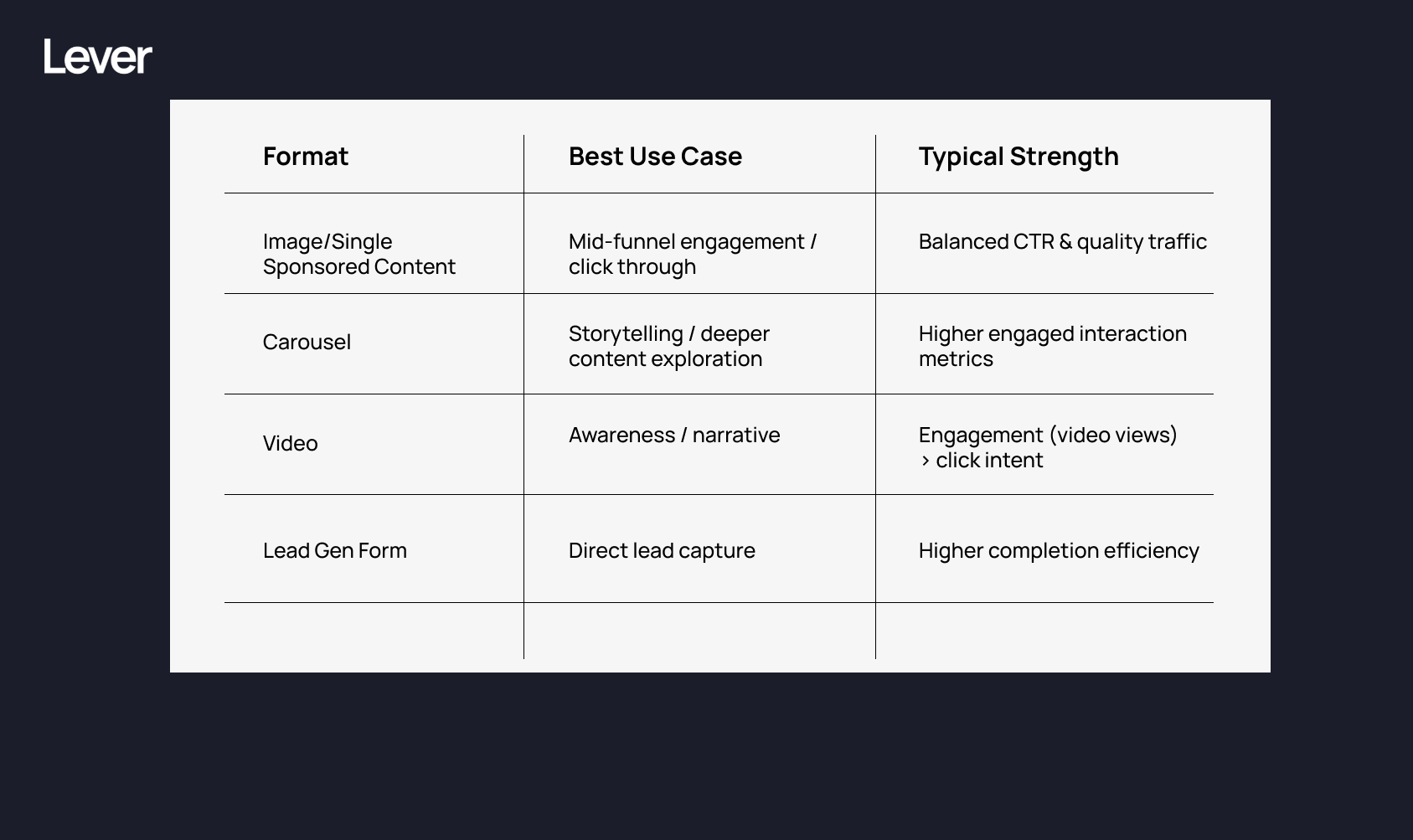
If your goal is pipeline acceleration, you don’t optimise solely for robotic CTR numbers, you optimise for conversion relevance.
How to Use These Benchmarks Wisely
Benchmarks are orientation tools, not absolute goals. Use them to:
✔ Diagnose whether performance is genuinely off-track
✔ Set realistic targets based on your vertical and ICP
✔ Evaluate format performance against appropriate peers (e.g., lead gen forms vs. video)
✔ Build internal benchmarks by campaign objective over time
For example, if your video ads are consistently showing a CTR below 0.4% but view completions are strong and follow-on metrics improve, your optimisation focus should be on CTA clarity and alignment with next steps rather than the CTR number itself.
Final Takeaways
Here’s a crisp, practical summary for B2B marketers:
- LinkedIn CTR averages ~0.44–0.65% for sponsored content, a B2B-appropriate baseline.
- Carousel engagement can boost apparent CTR metrics because interactions count more than pure clicks.
- Video ads show lower CTR if CTA isn’t explicit, engagement must be measured differently.
- Lead gen forms typically convert at ~6–10% once users interact.
- External site conversion rates are lower, ~1.5–3.5%, but expected.
- LinkedIn CPLs are high but aligned with quality audiences (often $60–$150+).
- Conversational ads show high engagement and conversion opportunities when used correctly.
Benchmarks don’t guarantee success, but they contextualise it. Use these figures as a compass, not a ruler, and always interpret them through your specific audience, campaign objective, and offer value lens.
For more information on Linkedin as a marketing channel read our article 12 Linkedin stats you should know for B2B marketing