.svg)




If your B2B Meta ads are underperforming, the instinct is to blame the platform. Meta is for consumers. The targeting is too broad. Your buyers are on LinkedIn. These are reasonable assumptions, and they are also the reason most B2B brands never get Meta to work.
The platform is not the problem. The targeting logic most B2B ppc teams bring to it is.
Meta has changed significantly over the past two years, and the direction of travel is clear: less manual control, more automation, and a system that rewards advertisers who feed it better signals rather than those who try to micromanage audience selection. B2B marketers who have not updated their approach are still fighting the platform instead of working with it.
The result is predictable: high CPLs, low lead quality, and a growing conviction that Meta simply does not work for B2B.
This article argues the opposite. By the end, you will understand:
- Why the most common B2B Meta targeting habits actively work against performance
- What changed in 2026 and why it actually creates an advantage for marketers with good first-party data
- How to structure B2B Meta campaigns that reach the right buyers without burning budget on the wrong ones
Why B2B Marketers Keep Wasting Budget on Meta
The waste is rarely random. It tends to come from the same three strategic errors, repeated across accounts of all sizes.
1. Treating Meta like a firmographic targeting engine
Meta is not LinkedIn. It does not hold verified job titles, seniority levels, or company sizes in the same way. When B2B teams try to recreate LinkedIn-style precision by stacking interest categories, it does not produce a tightly defined professional audience. It produces a small, expensive, poorly defined one. The algorithm has less room to work, signal quality drops, and CPLs climb without any corresponding improvement in lead quality.
2. Expecting cold campaigns to produce sales-ready pipeline
Running a direct demo or trial campaign to a cold audience on Meta and measuring it against pipeline contribution is a setup for disappointment. B2B buying decisions involve multiple stakeholders, long evaluation cycles, and a significant amount of trust-building before anyone fills in a form. A cold campaign that drives cheap form fills is not generating pipeline. It is generating data, at best.
3. Optimising for platform metrics rather than CRM outcomes
This is where budget waste hides most effectively. A campaign with a low cost per lead and a healthy click-through rate can look perfectly healthy in Ads Manager while producing almost no qualified pipeline. The gap between what Meta reports and what your CRM shows is where the real performance story lives. If you are not closing that loop, you are optimising toward numbers that do not reflect commercial reality.
What Changed in 2026, and Why It Actually Helps Smart B2B Advertisers
In March 2026, Meta removed detailed targeting exclusions from existing campaigns, completing a shift that had been underway for several years. The ability to manually exclude audiences by interest or demographic, once a staple of B2B campaign hygiene, is no longer available in the same form. For advertisers who relied on those controls to keep audiences tight, it felt like losing a key lever.
Here is the reframe: those controls were already losing effectiveness. Meta's algorithm had been deprioritising manual overrides in favour of its own signal-based targeting for some time. The March update simply formalised what was already happening in practice.
What this means is that the competitive advantage no longer lies in audience exclusion logic. It lies in the quality of the signals you feed the platform.
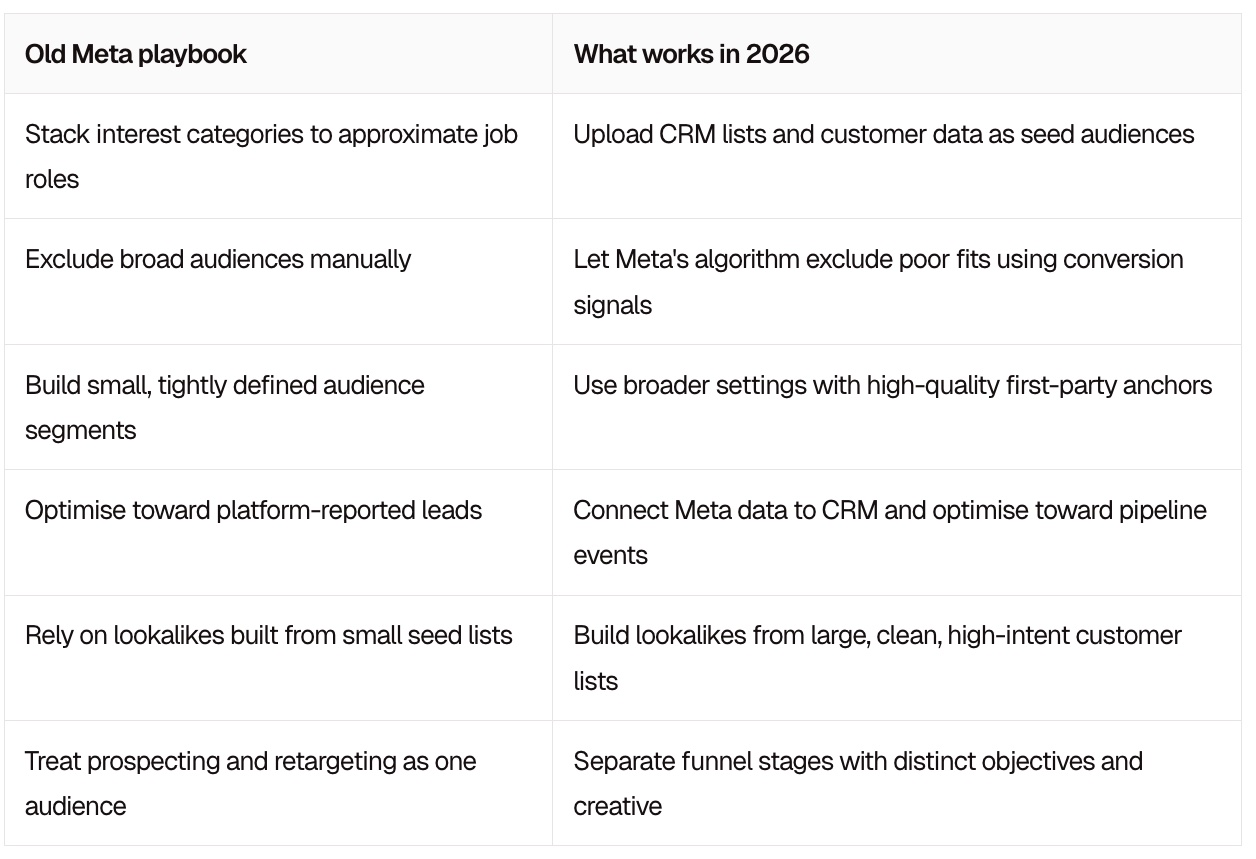
For B2B marketers with good first-party data, CRM lists, site visitor pools, and engaged audiences, this shift is genuinely favourable. The platform now rewards the inputs that B2B teams are actually in a position to provide, if they choose to use them.
How to Reach a B2B Audience on Meta Without Wasting Budget
The following framework is not a beginner's walkthrough. It is a structural approach for B2B teams who already have campaigns running but are not seeing the pipeline contribution they expected. This is where the Lever Digital paid social approach starts: with audience architecture, not creative.
Step 1: Build your audience from signals you already own
Stop starting with Meta's interest categories. Start with the data your business has already generated.
- Upload your CRM contact list as a custom audience
- Create a website visitor audience from your Meta Pixel, segmented by page type (pricing, product, case studies)
- Build a video engagement audience from anyone who has watched 50% or more of your content
- Add a lead form engagement audience of people who opened but did not submit
These are your warmest audiences. They are also the seed data Meta needs to build accurate lookalikes for prospecting. A lookalike built from 500 closed-won customers will outperform one built from 5,000 cold email subscribers every time.
Step 2: Separate your funnel stages with distinct campaigns
Running a single campaign to a mixed audience is one of the most common structural mistakes in B2B Meta accounts. Prospecting, retargeting, and conversion-stage campaigns need separate objectives, separate creative, and separate measurement benchmarks.
- Prospecting: Broad audience, awareness or traffic objective, content-led creative (thought leadership, problem framing, short video)
- Retargeting: Custom audiences from site visitors and engaged users, consideration objective, case study or comparison creative
- Conversion: Warmest audiences only, lead gen or conversion objective, direct offer with a clear next step
This separation gives Meta cleaner behavioural signals to learn from. It also prevents your bottom-of-funnel budget from being wasted on people who have never heard of your brand.
Step 3: Make the creative do the targeting work
Because Meta cannot reliably filter by job title, your creative has to. An ad that opens with "Struggling to attribute pipeline to paid social?" self-selects for the right reader. An ad that says "Grow your business" does not.
- Lead with a specific business problem, not a product feature
- Reference the role or context of your ideal buyer in the first line
- Use offer types that match funnel stage: guides and webinars for awareness, demos and audits for conversion
Step 4: Measure what actually matters
Platform CPL is a vanity metric for B2B. The number that matters is qualified pipeline influenced by Meta spend. To get there:
- Implement the Conversions API alongside your Meta Pixel for more reliable signal transmission
- Pass CRM lead quality data back to Meta so the algorithm can optimise toward better-fit leads
- Review Meta's contribution at the MQL and SQL level, not just the form fill level
When Meta Is the Wrong Channel for B2B
The case for Meta in B2B is real, but it is not universal. Part of spending budget well is knowing when a channel is not the right fit.
Meta tends to work well for B2B when:
- You have an existing CRM list or customer base large enough to build meaningful custom audiences
- Your product or service addresses a broadly experienced business problem, not a highly niche role
- You are running full-funnel campaigns rather than expecting cold traffic to convert directly
- You need cost-efficient reach for brand awareness and demand shaping alongside higher-intent channels
- You want to retarget warm audiences from paid search or LinkedIn at a lower CPM
Meta tends to underperform for B2B when:
- Your total addressable market is very small and requires account-level precision that only ABM-style targeting can provide
- You have no first-party audience data to anchor campaigns, making signal quality too weak to train the algorithm effectively
- Your offer requires a high degree of trust before a prospect will engage, and your brand has no existing awareness in the market
- You are measuring success purely by direct demo bookings from cold audiences, without any upper-funnel investment
The honest position is that Meta rarely works as a standalone B2B demand channel. It works as part of a multi-channel paid strategy where it handles reach, retargeting, and demand shaping while other channels close intent.
The Practical Test: Should You Keep Spending on Meta or Rework the Account?
Before cutting Meta budget or scaling it, run a quick account audit against these signals. The answers will tell you whether you have a channel problem or a setup problem.
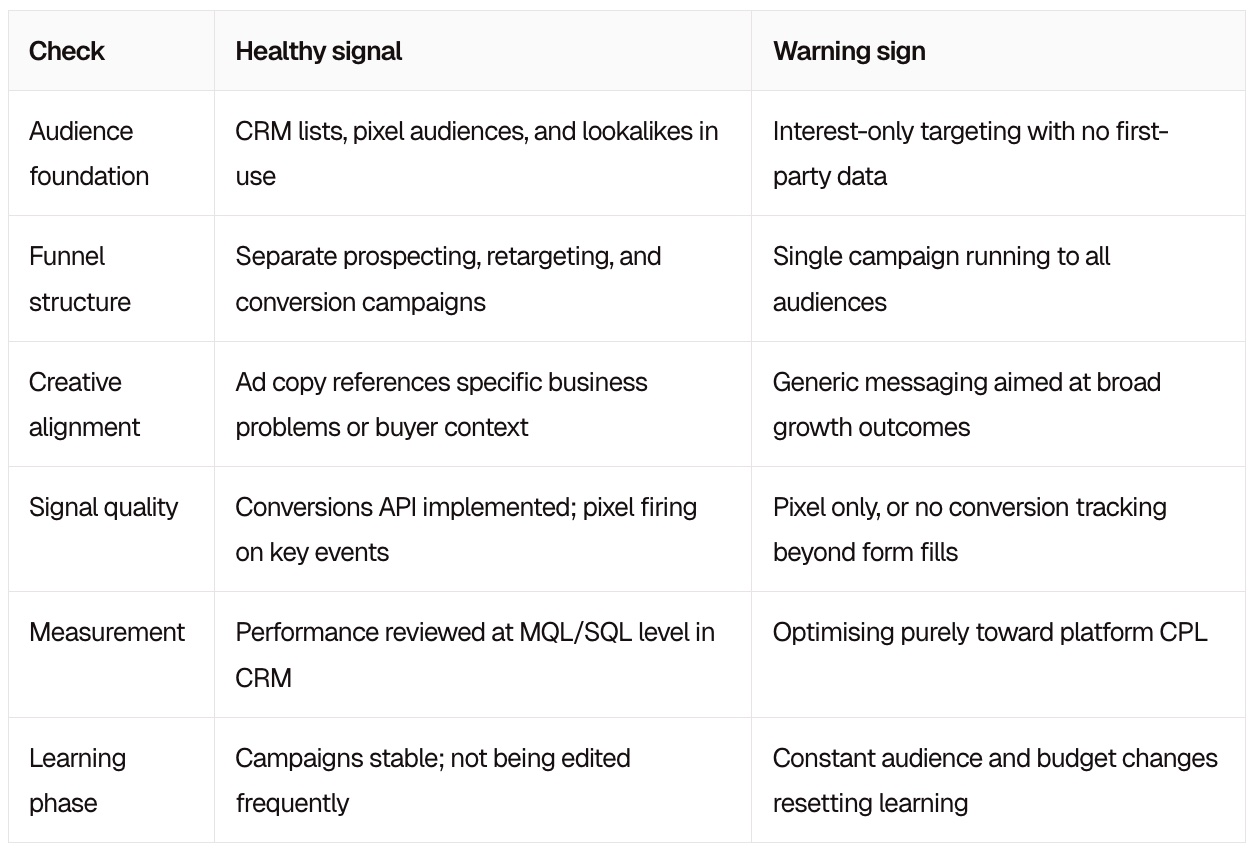
If most of your answers land in the warning column, the problem is not Meta. It is the account structure.
The practical implication: do not cut spend on a poorly structured account and conclude that Meta does not work for B2B. Fix the structure first. Rebuild audience foundations using first-party data, separate your funnel stages, tighten your creative around specific buyer problems, and give campaigns enough stability to exit the learning phase before drawing conclusions.
If most signals are healthy and performance is still weak, then it is worth reassessing whether Meta is the right fit for your specific sales motion, as covered in the section above.
Stop Buying the Wrong Lesson from Bad Meta Performance
Poor B2B Meta performance is almost always a strategy problem, not a channel verdict. The platform has moved on. Most B2B targeting approaches have not.
The core argument of this article, in brief:
- Meta's 2026 changes reduce the value of manual audience control and increase the value of first-party data and signal quality
- B2B success on Meta requires full-funnel campaign structure, not cold lead-gen campaigns measured against pipeline
- Creative has to do the audience filtering that targeting cannot
- The right measurement frame is qualified pipeline, not platform CPL
For B2B teams willing to work with Meta's current system rather than against it, the platform can be a cost-efficient way to build awareness, warm audiences, and support conversion across the buying cycle. It is not a replacement for paid search or LinkedIn. It is a complement to them, when used correctly.
If you are not sure whether your Meta account is structured to work in 2026, book a paid social strategy call with Lever Digital. We will tell you exactly what needs to change.