.svg)




If your B2B Google Ads campaigns are generating clicks but not converting, the problem almost certainly isn't your bidding strategy. It isn't your Quality Score. And it isn't your ad copy.
It's your funnel, specifically, the part most advertisers completely ignore.
B2B buying decisions are long. They involve multiple stakeholders, extended research phases, and a lot of "not yet" before a single "yes." Yet the vast majority of Google Ads campaigns are built as if the buyer journey goes: search query → ad click → contact form. That's not a funnel. That's wishful thinking.
The uncomfortable truth: most B2B Google Ads accounts are running a top-of-funnel awareness campaign and a bottom-of-funnel conversion campaign, with absolutely nothing in between. The middle of the funnel, the stage where real purchase intent is formed, is a graveyard of missed opportunity.
This post is about why that happens, what it costs you, and what a properly built B2B funnel actually looks like.
The Three-Stage Funnel (and Where Everyone Falls Down)
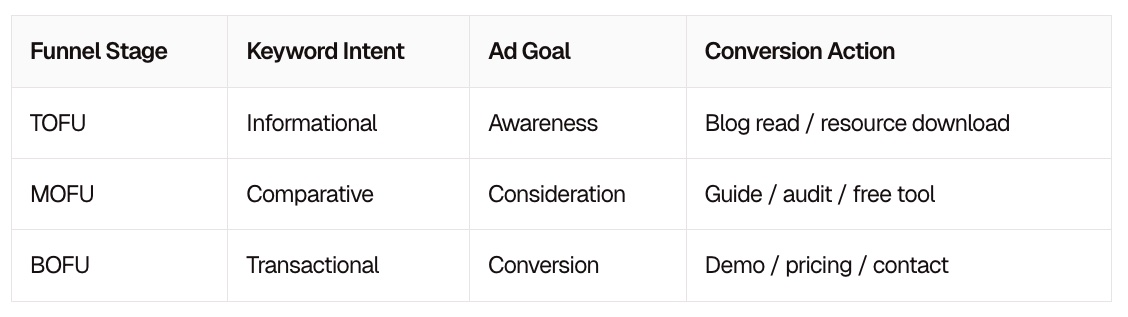
Before we get into the failure points, let's establish the framework. A B2B Google Ads funnel has three distinct stages, each requiring a different approach to keywords, ad messaging, landing pages, and conversion goals.
Top of Funnel (TOFU): Awareness
The buyer knows they have a problem but hasn't committed to a solution. They're searching for information and education. Keywords here are broad and research-oriented: "how to reduce staff turnover," "what is marketing automation," "ways to improve cash flow."
Middle of Funnel (MOFU): Consideration
The buyer is actively evaluating solutions. They know the category exists and they're narrowing down their options. The search intent shifts from "what is this?" to "what's the right fit for my situation?" Keywords reflect that nuance: "accounting software for growing professional services firms," "best marketing automation for small B2B teams," "IT support options for multi-site businesses."
These aren't brand searches or competitor comparisons, they're category searches with qualifying context. The buyer is telling you exactly where they are in their thinking, and most advertisers aren't listening.
Bottom of Funnel (BOFU): Decision
The buyer knows what they need. They're deciding who to buy it from. Queries here are specific about category, features, or geography: "enterprise HR software with payroll integration," "cloud accounting software for 50+ users," "outsourced IT support London." High intent, high competition, and only one part of the picture.
Here's where it goes wrong. Most campaigns pour budget into BOFU keywords (because the intent is obvious) and occasionally dabble in TOFU content campaigns (because they're cheap to run). MOFU gets nothing, no dedicated campaigns, no tailored landing pages, no nurture sequences.
The result? You're paying to reach people who are either not ready to buy, or so ready to buy that they're already comparing you against three other vendors. The middle, where you could actually influence the decision, is completely unaddressed.
Why MOFU Is Uniquely Hard in B2B
In B2C, the middle of the funnel is relatively forgiving. Someone browsing trainers might see a remarketing ad and convert the same day. The consideration phase is short, often emotional, and heavily influenced by price and aesthetics.
B2B is completely different. Here's what makes MOFU so challenging, and why most advertisers give up on it:
- Multiple decision-makers. The person clicking your ad is rarely the person signing the contract. You might be winning over the operations manager while the CFO is still unconvinced. Your MOFU content needs to speak to both.
- Long consideration cycles. B2B software and services deals can take weeks or months to close. A single ad click at the consideration stage won't convert immediately, and most accounts aren't set up to track or nurture that journey.
- High research intensity. B2B buyers read case studies, compare vendors, watch demos, and consult peers before committing. If your funnel doesn't serve that research behaviour, you're invisible during the most influential part of the process.
- Attribution blind spots. Because MOFU conversions don't happen immediately, they're harder to attribute. Most Google Ads accounts default to last-click attribution, which gives all the credit to the BOFU touchpoint and makes MOFU campaigns look like they're not working, even when they're doing the heavy lifting.
That last point is particularly damaging. When a campaign can't demonstrate ROI in a dashboard, it gets paused. MOFU campaigns get paused all the time, not because they fail, but because the measurement framework doesn't capture what they actually do.
The Symptoms of a MOFU Gap (Do Any of These Sound Familiar?)
You don't always know your funnel has a middle problem. The symptoms often look like something else entirely. Here's what a MOFU gap typically looks like from the inside:
"We're getting clicks but no enquiries."
Your TOFU and BOFU campaigns are running, but there's no bridge. Buyers click, land on a generic page, see nothing that speaks to where they are in their journey, and leave.
"Our cost per lead is sky-high."
When you only target BOFU keywords, you're in the most competitive, most expensive part of the auction. Everyone's bidding on the same high-intent queries, but far fewer are bidding on the consideration-stage searches where buyers are still forming a preference.
"We get leads but they're not converting to sales."
TOFU campaigns can drive volume, but the leads are too early. They need nurturing. Without a MOFU layer to qualify and educate, your sales team is doing all the heavy lifting that your funnel should be doing.
"Remarketing isn't working."
If you're remarketing to everyone who visited your site with the same BOFU ad, you're ignoring where they actually are in the funnel. Someone who read your blog post needs different messaging than someone who viewed your pricing page.
If two or more of those sound familiar, the middle of your funnel is the problem, not your bids, not your ad copy, not your landing page headline.
What a Proper B2B Google Ads Funnel Actually Looks Like
Building a funnel that works across all three stages isn't complicated, but it does require intentional structure. Here's how we approach it.
TOFU: Cast a Wide Net, But Stay Relevant
Top-of-funnel campaigns should target informational and research-based keywords. The goal isn't conversion, it's building an audience of relevant in-market buyers. Think Performance Max campaigns with strong audience signals, or Search campaigns targeting problem-aware queries.
The conversion goal here is a micro-conversion: a blog read, a resource download, a video watch. You're not asking for a sales call. You're building a remarketing list of people who've shown interest.
MOFU: This Is Where the Work Happens
Middle-of-funnel is where your campaigns need to do the most strategic work. This means:
- Segmented remarketing lists: based on pages visited (someone who visited your case studies page is further along than someone who read a blog post)
- Consideration-stage keywords: category searches with qualifying context that signal the buyer is actively evaluating, not just researching
- Content offers: whitepapers, webinars, ROI calculators, and free audits that give value in exchange for a deeper relationship
- Tailored landing pages: that speak to the consideration stage, not the decision stage. "Here's why we're the right fit" rather than "Book a call now."
The MOFU conversion goal is a mid-commitment action: a guide download, a newsletter signup, a free tool use. Something that moves the buyer forward without demanding a sales conversation they're not ready for.
BOFU: Close What You've Warmed Up
Bottom-of-funnel campaigns should be tightly targeted, well-funded, and conversion-focused. But here's the key difference when you have a proper funnel: your BOFU audience is already warm. They've consumed your TOFU content. They've engaged with your MOFU offers. When they see your conversion-focused ad, they're not strangers, they're buyers who already trust you.
That changes everything. Your conversion rates go up. Your cost per acquisition comes down. And your sales team is talking to leads who already understand your value proposition.
The Attribution Fix Nobody Wants to Talk About
Here's the part where I'll probably upset a few people.
Most agencies report on last-click conversions because it's simple, it looks clean in a dashboard, and it makes BOFU campaigns look brilliant. But last-click attribution is a lie, or at least, a very incomplete version of the truth.
If a buyer clicks your TOFU ad in January, downloads your guide from a MOFU campaign in February, and then converts via a BOFU search in March, your last-click report will credit the March keyword. The January and February campaigns look like they did nothing. So they get cut. And then your March conversions start drying up, and nobody can figure out why.
The fix isn't glamorous, but it's essential:
- Switch to data-driven attribution in Google Ads. It distributes credit across all touchpoints in the conversion path, not just the last one.
- Set up Google Analytics 4 properly and use the path analysis reports to see how buyers actually move through your funnel.
- Define micro-conversions for TOFU and MOFU stages, and report on them separately. A MOFU campaign's job is to generate guide downloads, not direct sales enquiries. Measure it accordingly.
- Give campaigns time. B2B sales cycles are long. A campaign that looks flat at 30 days might be a significant revenue driver at 90 days. Patience, combined with proper attribution, is what separates good B2B advertisers from great ones.
Getting attribution right won't just make your reporting more accurate; it'll stop you from pausing the campaigns that are quietly doing the most important work.
Stop Blaming the Ads
When a B2B Google Ads campaign underperforms, the instinct is to blame the obvious things: the bids are too low, the ad copy isn't compelling enough, the landing page needs a redesign. Sometimes those things are true. But more often, the problem is structural.
You can have the best ad copy in the world and still lose if you're sending a consideration-stage buyer to a decision-stage landing page. You can have a perfectly optimised BOFU campaign and still struggle if you haven't built the trust and familiarity that MOFU creates.
The middle of the funnel isn't a nice-to-have. In B2B, it's the engine. It's where buyers decide whether to trust you, whether you understand their problem, and whether you're worth a conversation. If your campaigns skip it, you're not running a funnel, you're running two disconnected ad sets and hoping the gap doesn't cost you too much.
Most of the B2B PPC accounts we audit at Lever Digital have exactly this problem. The BOFU campaigns are technically sound. The TOFU activity is generating impressions. But the middle is empty, and the pipeline reflects it.
If that sounds like your account, we'd be glad to take a look. Request your free proposal and we'll give you an honest assessment of where your funnel is leaking and exactly what to do about it.