.svg)




If you've opened Google Ads recently, you've probably been nudged to "upgrade to Performance Max" at least three times. Now there's a new option on the table: AI Max for Search, which arrived in beta in May 2025 and rolled out globally by Q3. So which campaign type should a B2B advertiser actually be running?
The honest answer is that most B2B businesses are asking the wrong question. The choice isn't Performance Max vs Search vs AI Max. It's about understanding what each one is built to do, and matching that to where you are in your Google Ads maturity and how much learning you are willing to put up with (or pay for!)
Here's the full picture.
What Each Campaign Type Actually Does
Before getting into recommendations, it's worth being precise about what these three things are, because "AI Max" is frequently confused with Performance Max, and they are fundamentally different.
Search Campaigns
Traditional Search campaigns show text ads to users based on keyword matching. You control the keywords, the match types, the ad copy, the landing pages, and the negative keyword lists. The algorithm handles bid optimisation within the parameters you set. This is the most transparent campaign type Google offers, and for B2B, that transparency matters.
Performance Max (PMax)
Performance Max is a goal-based campaign type that runs across all of Google's inventory: Search, Display, YouTube, Gmail, Discover, and Maps. You provide creative assets and audience signals, and Google's AI decides where to show your ads, to whom, and at what bid. You give up control in exchange for reach and automation. PMax needs volume to learn; Google recommends at least 30 to 50 conversions per month for the algorithm to optimise effectively.
AI Max for Search
AI Max is not a new campaign type. It is an upgrade layer that sits on top of your existing Search campaigns. Announced in May 2025 on the Google Ads blog, it adds three core capabilities to Search:
- Search term matching: Expands beyond your keywords using broad match and keywordless technology to find relevant queries you weren't targeting
- Text customisation: Dynamically generates headlines and descriptions based on your landing pages, existing ads, and keywords
- Final URL expansion: Routes users to the most relevant page on your site, not just the URL you specified
The critical distinction: AI Max keeps you inside the Search campaign structure. You retain keyword-level reporting, negative keyword control, and ad group architecture. You're adding intelligence, not handing over the wheel.

Why Search Wins for B2B (and the Data Behind It)
B2B buying is not an impulse decision. A buyer researching payroll software, a compliance tool, or a managed IT service is running a deliberate, multi-touch evaluation process. They search specific terms. They compare options. They read landing pages. They come back. That behaviour maps almost perfectly to how Search campaigns work.
The numbers bear this out. Across 247 accounts tested over 18 months covering $18.7 million in ad spend, B2B SaaS advertisers running Search campaigns achieved a 51% lower customer acquisition cost than those running Performance Max. The specifics are stark:
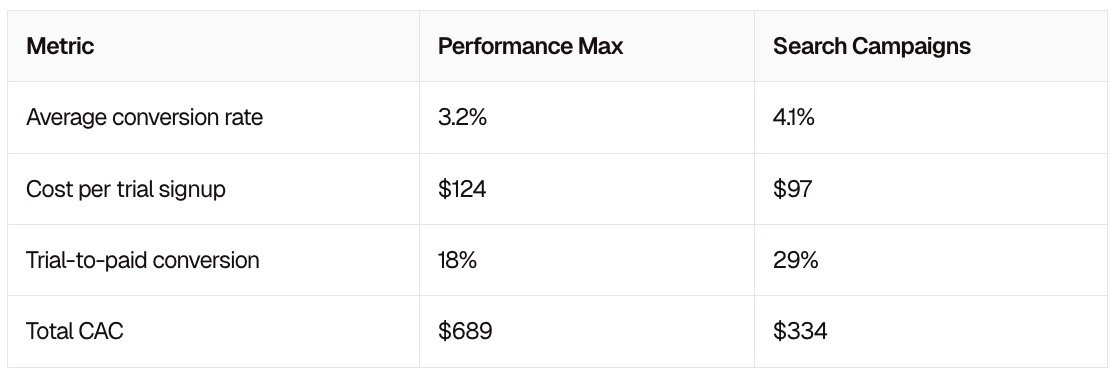
2That trial-to-paid gap is the one that should concern B2B marketers most. PMax may generate more top-of-funnel volume, but if those leads don't convert downstream, the economics collapse. Search campaigns attract buyers who searched a specific term, read an ad that matched their intent, and clicked through to a relevant page. The intent signal is much stronger.
The Lead Quality Problem with PMax
Performance Max has a well-documented lead quality problem in B2B contexts, and it comes down to conversion tracking. Without offline conversion data fed back into Google Ads (connecting your CRM to show which form fills became actual customers), PMax optimises for whatever conversion event you've defined, typically a form submission. It has no way to know whether that lead was a qualified prospect or someone who clicked by accident.
The result: high volume, low quality. Lead quality scores in independent testing averaged 6.8 out of 10 for PMax versus 7.9 for Search in lead generation accounts. That gap compounds over time, as PMax continues to optimise toward the wrong signal.
The fix exists, but it requires work. Offline conversion tracking via your CRM (Salesforce, HubSpot, or similar) closes the loop and gives PMax the signal it needs to optimise for pipeline, not just form fills. If you haven't built that infrastructure, PMax is flying blind in B2B.
Where AI Max Fits In: The Case for Upgrading Your Search Campaigns
AI Max is the most compelling development for B2B Search advertisers since Smart Bidding. The reason is simple: it extends the reach of your existing campaigns without sacrificing the transparency and control that make Search valuable for B2B in the first place.
What AI Max Actually Unlocks for B2B
The most valuable feature for B2B advertisers is search term matching. B2B buyers increasingly search in natural language: "software to automate invoice approval for mid-market finance teams" rather than "invoice automation software." A keyword list built around exact and phrase match terms will miss a large portion of that intent. AI Max's keywordless technology reads your landing pages, existing ads, and keywords to identify relevant queries you weren't bidding on.
For SaaS businesses with well-structured product and solutions pages, this is particularly powerful. The AI can connect complex, multi-word queries to the right part of your site without you having to anticipate every variation.
The One Feature to Handle with Care
Final URL expansion is where B2B advertisers should proceed cautiously. In theory, routing users to the "most relevant" page sounds helpful. In practice, if your campaign goal is a specific demo request or contact form, you do not want Google redirecting traffic to a blog post it considers "more relevant." The fix is straightforward: use URL exclusions to block pages you don't want serving as landing pages, and pin your primary conversion pages.
Key takeaway: Turn on AI Max for Search, but disable final URL expansion unless you have a well-structured site and have set up URL exclusions. The search term matching and text customisation features are the real value drivers.
AI Max vs PMax: Why They're Not the Same Thing
A common misconception is that AI Max is a lighter version of Performance Max. It isn't. PMax runs across all Google inventory and removes keyword control entirely. AI Max runs only on Search and preserves your campaign architecture. The reporting in AI Max shows you which expanded search terms matched, which headlines Google generated, and which landing pages were served. PMax gives you almost none of that granularity.
For B2B advertisers who want to stay in the Search channel but extend their reach intelligently, AI Max is the right tool. PMax serves a different purpose entirely.
When Performance Max Does Make Sense for B2B
Performance Max is not the wrong choice for B2B. It's the wrong starting point. There are specific scenarios where PMax adds genuine value, and they all share a common prerequisite: you need enough data for the algorithm to do its job.
The Prerequisites for PMax to Work in B2B
Before running Performance Max for lead generation, you need:
- Offline conversion tracking connected to your CRM, so PMax optimises for pipeline quality, not just form fills
- At least 30 to 50 conversions per month to give the algorithm sufficient learning data
- A working Search campaign that already converts, so you have a performance baseline
- Brand exclusions set at account level to stop PMax cannibalising branded traffic you'd win organically anyway
If you don't have all four in place, the risk of PMax generating high-volume, low-quality leads is significant. Get Search working first.
The Right Role for PMax in a B2B Account
Once those prerequisites are met, PMax plays a useful supporting role. The accounts that perform best aren't choosing between Search and PMax; they're running both with clearly defined jobs.
- Search (with AI Max): High-intent branded and non-branded terms, competitor terms, specific product and solution searches. This is your primary conversion engine.
- Performance Max: New audience discovery, retargeting warm visitors across YouTube and Display, and expanding reach beyond the search channel to audiences who haven't yet entered the buying cycle.
In a study of 41 accounts running both campaign types with clear role definitions, the combined approach delivered a 5.9% conversion rate and $54 CPA, beating either campaign type alone by 23 to 38%. The key word is "clear role definitions." PMax without a defined brief will compete with your Search campaigns for the same traffic and inflate its own reported ROAS by claiming credit for conversions it didn't drive.
The cannibalisation trap is real. If someone searches your brand name and PMax shows them an ad, that click shows up in PMax reporting as a win. In reality, you'd have got that click for free through organic. Always apply brand exclusions to PMax, and monitor the search terms report in your Search campaigns to check for overlap.
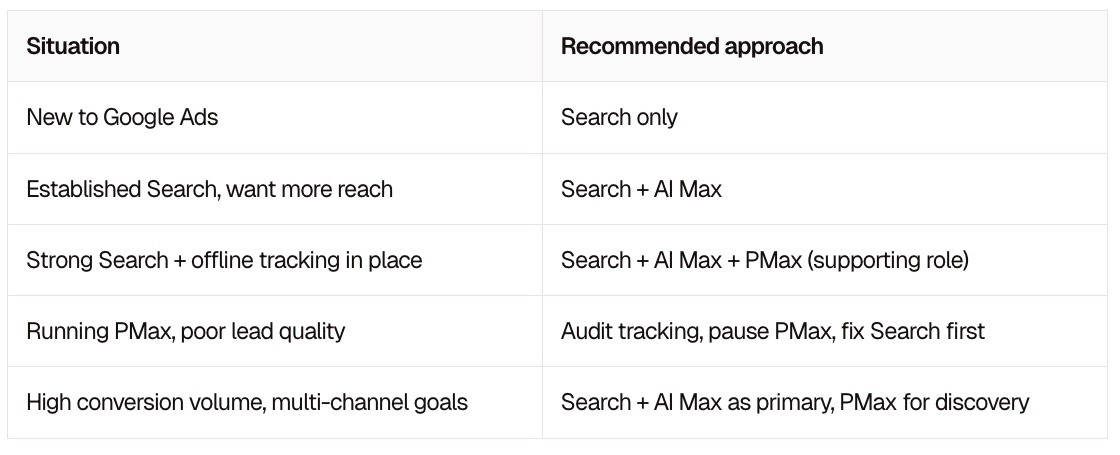
The B2B Decision Framework: Which Campaign Type for Your Situation
Rather than a one-size-fits-all recommendation, here's how to think about your specific situation.
If you're new to Google Ads or rebuilding from scratch
Start with Search. Build your keyword structure, establish conversion tracking, and prove the channel works before introducing automation. Once you have a consistent volume of conversions and a clear sense of which terms drive quality leads, layer on AI Max to extend your reach.
If you're running Search and hitting keyword coverage limits
This is the ideal moment to activate AI Max. You've already got a working campaign structure. AI Max will find queries you're missing without disrupting what's already performing. Enable search term matching, review the expanded terms weekly for the first month, and add negatives aggressively for anything irrelevant.
If you're running Search and want to test PMax
Ensure you have offline conversion tracking in place first. Set up PMax with a separate budget, apply brand exclusions, and give it a clear brief: new audience discovery and upper-funnel reach, not direct response. Run it alongside Search, not instead of it, and compare pipeline quality (not just form fills) across both.
If you're already running PMax and not seeing quality leads
Pause and audit your conversion tracking setup. If you're optimising for form submissions without CRM feedback, PMax has been learning from the wrong signal. Connect your CRM data, rebuild your audience signals using your existing customer list, and give the algorithm 4 to 6 weeks to re-learn before drawing conclusions.
The bottom line on campaign type selection:
The Bigger Picture: AI Max and the Future of B2B Search
There's a strategic reason to pay attention to AI Max beyond the immediate conversion uplift. Google is increasingly integrating ads into AI Overviews and AI Mode within Search. Eligibility to appear in those placements requires AI-powered targeting. Advertisers running traditional keyword-only campaigns may find themselves excluded from a growing share of search real estate as AI-generated responses become more prominent.
This makes AI Max less of an optional enhancement and more of a necessary evolution for B2B advertisers who want to maintain visibility as search behaviour shifts. B2B buyers are already searching in longer, more conversational queries. AI Max is built for exactly that pattern.
The good news is that activating AI Max doesn't mean surrendering control. The transparency improvements are real: you can see the exact expanded search terms, the headlines Google generated, and the landing pages served. That reporting visibility is what makes it compatible with B2B advertising, where accountability for lead quality is non-negotiable.
For most B2B marketing managers and in-house PPC leads, the right move in 2026 is clear: run Search as your foundation, activate AI Max to extend reach and capture intent you're currently missing, and only introduce Performance Max once your conversion tracking infrastructure can support it. That sequence isn't cautious; it's how you build a paid search programme that generates pipeline, not just clicks.