Use this banner section for site-wide announcements, news updates, big changes and more.

.svg)


Most articles about PPC costs will hand you a range so wide it's useless. "Between £500 and £50,000 a month", thanks, very helpful. This guide is different. It gives you the real numbers for PPC SaaS Agencies in the UK, explains what drives costs up, and tells you bluntly what your budget should be delivering at every level.
Because here's the problem: PPC for B2B SaaS is expensive. CPCs are high, sales cycles are long, and attribution is messy. That combination makes it very easy to spend a lot and measure very little. Plenty of founders have done exactly that, writing off PPC as "not working" when the real issue was either an underpowered budget, the wrong channel, or an agency optimising for clicks instead of pipeline.
The honest truth: PPC works exceptionally well for B2B SaaS when the budget is right, the targeting is sharp, and you're measuring the right things. It fails, expensively, when any of those three are missing.
This guide covers what you'll actually pay, what you should get for it, and how to tell the difference between a campaign that's building a pipeline and one that's quietly burning your budget.
Let's start with the number everyone wants: the cost per click.
For B2B SaaS keywords on Google Search in the UK, you're looking at an average of £3 to £6 per click in 2026. That's the broad middle ground. Highly competitive categories, cybersecurity, HR software, fintech, ERP, routinely push past £15 per click, and enterprise keywords targeting procurement teams or IT directors can go higher still.
For context, the average CPC across all UK industries on Google Search sits around £1.95. B2B SaaS pays roughly double that baseline, simply because the commercial intent is high and the lifetime value of a won deal justifies aggressive bidding from well-funded competitors.
The CPC is just the start. Here's what the full picture looks like:

The CPL range is wide because it's highly sensitive to your offer, landing page quality, and how competitive your specific keywords are. A well-optimised campaign targeting mid-market HR software buyers will perform very differently from a cold campaign targeting CFOs for enterprise spend management tools.
Three factors drive costs above the industry average:
This is where a lot of founders get burned. They allocate £500 or £1,000 a month to "test" PPC, see poor results, and conclude the channel doesn't work. The real conclusion is that the budget was too small to generate meaningful signal.
The minimum viable spend for B2B SaaS PPC in the UK is £3,000 to £3,500 per month in ad spend. Below that threshold, you won't generate enough clicks to optimise bidding strategies, enough conversions to train Google's algorithm, or enough data to make informed decisions about what's working.
That's ad spend alone. Add agency management fees on top.
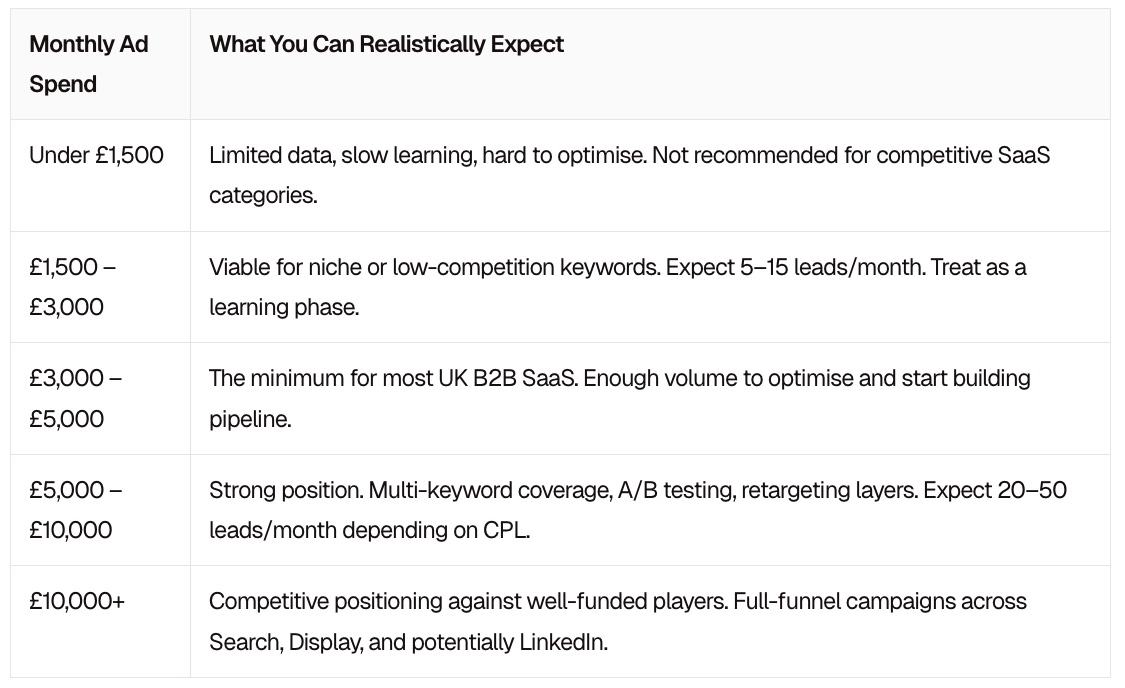
The right budget depends on your average contract value (ACV). If a single customer is worth £20,000 ARR, spending £3,500/month to acquire one customer per month is a perfectly rational investment. If your ACV is £500, the maths simply won't work at most budget levels.
Most UK PPC agencies structure fees in one of two ways:
Be cautious of percentage-based models if you're planning to scale spend significantly. The agency's incentive becomes growing your budget rather than improving your return on it. Flat retainers align incentives better at higher spend levels.
Watch out for: Agencies that quote low management fees but charge separately for landing page builds, creative, reporting dashboards, and strategy calls. The headline number can look attractive while the total cost runs 2x higher.
Most SaaS founders default to Google Ads and never look elsewhere. That's understandable, it's the largest search network and the most familiar. But for B2B SaaS specifically, the platform mix matters more than most people realise.
Google remains the go-to for capturing active demand. When a VP of Operations searches "workforce management software UK," they want a solution now. That intent is valuable, and Google captures it better than any other platform.
The trade-off is cost. Google's average ROI for B2B sits around 200% (£2 returned per £1 spent), which sounds good until you factor in that you're often paying £4–£8 per click for keywords with a 3–5% conversion rate to lead, and then a further 5–15% close rate from lead to customer.
Microsoft Ads (Bing) is consistently overlooked by B2B SaaS marketers, and that's precisely why it's worth considering. With CPCs running roughly 40% lower than Google, and an ROI benchmarked at around 253% versus Google's 200%, the economics are genuinely better for many campaigns.
The audience skews slightly older and more enterprise-heavy, which suits many B2B SaaS products well. It won't replace Google's volume, but running a mirrored campaign on Microsoft Ads alongside Google is one of the most straightforward wins available to UK SaaS marketers.
LinkedIn is the most expensive channel by CPL, with cost-per-lead often running 3–4x higher than Google Search. Most founders look at that number and walk away. That's a mistake.
The data on actual customer acquisition cost tells a different story:
LinkedIn's higher CPL is offset by significantly better lead quality. When you're targeting by job title, company size, and industry, you're reaching the actual decision-makers rather than a broad search audience that includes researchers, students, and competitors. For enterprise SaaS with ACVs above £15,000, LinkedIn's pipeline quality often justifies the cost.
The recommended platform mix for most UK B2B SaaS companies:
This is the section most PPC guides skip entirely. They'll tell you what things cost but not what results you should hold your campaigns (and your agency) accountable for.
Here are the benchmarks that matter for B2B SaaS in the UK:
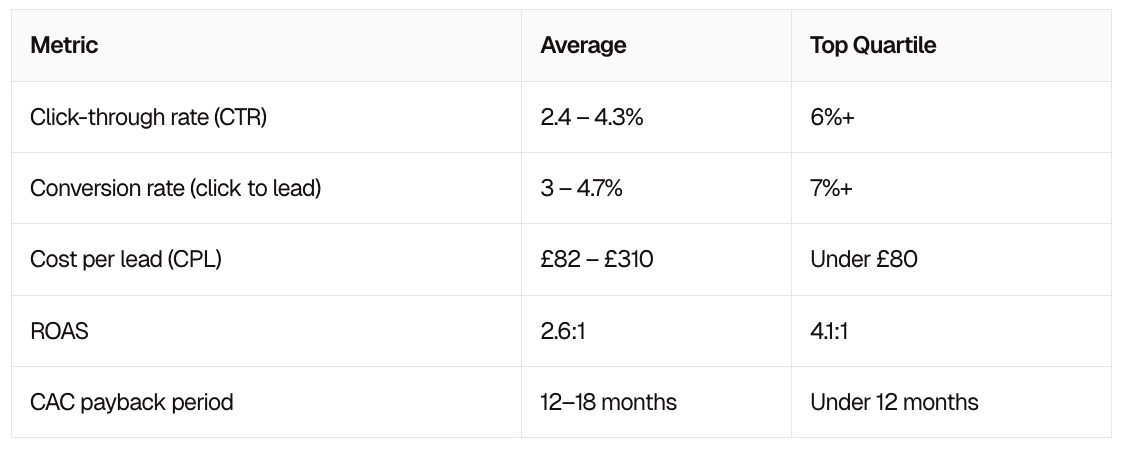
A few things worth flagging about these numbers:
ROAS is a limited metric for SaaS. The average ROAS for B2B SaaS sits at around 2.6:1, compared to 3.5:1 across all industries. That looks worse, but it's misleading. SaaS revenue is recurring. A customer acquired at a 2:1 ROAS in month one might deliver 10:1 over a three-year contract. The metric that actually matters is LTV:CAC ratio, and specifically how long it takes to pay back your acquisition cost.
Most companies aren't measuring this properly. Only 43% of B2B companies have full-funnel reporting that connects ad spend to closed revenue. The rest are optimising for leads or cost per lead, which means they're often optimising for the wrong thing entirely. A campaign generating cheap leads that never close is worse than a campaign generating expensive leads that become six-figure contracts.
If you're working with a PPC agency, these are the reporting basics you should be receiving every month:
If your agency is sending you a report that stops at "impressions, clicks, CTR," they're not doing the job. You're paying for pipeline, not traffic.
Most wasted PPC budget doesn't disappear in one obvious disaster. It leaks slowly, through a combination of structural mistakes that are easy to miss if you're not looking for them.
These are the most common culprits in B2B SaaS campaigns:
Google's broad match has become increasingly aggressive. Without a robust negative keyword list, your ads will appear for searches that have no commercial relevance to your product. It's not uncommon to audit a B2B SaaS account and find 20–30% of spend going to irrelevant queries. That's budget that could be funding actual pipeline.
A click that lands on your homepage is a click that's been handed a puzzle to solve. Paid traffic should land on a dedicated, conversion-optimised page that matches the ad's message precisely. Homepage bounce rates for paid B2B traffic routinely run above 70%. A well-built landing page targeting the same audience can convert at 5–10%.
This is the measurement problem in practice. If your campaign is optimised for "demo requests" and your sales team closes 5% of demos, you might be celebrating a low CPL while your actual CAC is quietly 20x your CPL. The fix requires connecting your ad platform to your CRM and importing closed revenue as a conversion signal.
Google's Smart Bidding strategies (Target CPA, Maximise Conversions) require a minimum of 30–50 conversions per month to function properly. Below that, the algorithm is essentially guessing. If your budget only generates 5–10 conversions per month, you're not running an optimised campaign — you're running an expensive experiment with no statistical confidence.
The uncomfortable question to ask your current agency: "Show me the search terms report from the last 90 days." If there are dozens of irrelevant queries eating budget, and no evidence of negative keyword additions, that's a problem that should have been fixed months ago.
PPC isn't the right channel for every B2B SaaS company at every stage. Here's a straightforward framework for deciding whether the investment makes sense right now.
The bottom line: PPC is a high-efficiency channel for B2B SaaS when the conditions are right. The mistake most founders make isn't investing in PPC — it's investing without the budget, infrastructure, or measurement framework to make it work.
PPC done right is one of the most scalable acquisition channels available to B2B SaaS companies. The cost is real, but so is the return, provided the SaaS ppc agency you hire is the right one 😉

Lever Digital is proud to be a 2026 UK Paid Media Awards finalist, recognised for outstanding performance-led paid media campaigns across B2B and SaaS.


.png)
