Use this banner section for site-wide announcements, news updates, big changes and more.

.svg)

If you have been through a bad agency relationship, you already know the pattern. Impressive pitch. Polished deck. Lots of talk about impressions, CTR, and "brand awareness." Then three months in, your pipeline looks exactly the same and the agency is explaining why the metrics that actually matter will take time.
The problem is rarely that B2B PPC does not work. It is that most agency selection processes are built around the wrong signals: certifications, client logos, and how confident someone sounds in a meeting. This guide is built around a different question: what does a genuinely strong B2B PPC agency actually deliver, and how do you verify it before you sign anything?
The core issue: Most agencies are optimised for winning pitches, not delivering pipeline. The evaluation framework you use determines which type you end up with.
Here is what good looks like, across five dimensions that matter.
The single most reliable indicator of a strong B2B PPC agency is what they choose to report on. A weak agency reports platform metrics: clicks, impressions, CTR, cost per click. These numbers live entirely inside Google Ads or LinkedIn Campaign Manager. They tell you nothing about whether your pipeline is growing.
A strong agency reports on what happens after the click: qualified leads, cost per qualified lead, MQL-to-SQL conversion rate, pipeline value attributed to paid, and ultimately, cost per acquisition against customer lifetime value.
Why this matters: According to Databox's PPC benchmark data, the median cost per conversion on Google Ads sits at around £57, but top-quartile performers bring this down to under £18. That gap does not come from better bidding. It comes from tighter audience targeting, stronger negative keyword discipline, and landing pages built for conversion, not just traffic.
In your first conversation with any prospective agency, ask them directly: "What metrics do you optimise against, and how do those connect to revenue?"
The right answer references qualified pipeline with a clear methodology for how quality is measured. The wrong answer stops at platform metrics.
Ask also whether they integrate with your CRM. If they cannot track from first click to closed-won, their reporting will always have a gap between what they claim to deliver and what your sales team actually sees. Any agency that pretends B2B attribution is straightforward should be treated with scepticism. It is genuinely complex. What you are looking for is an agency that has built a consistent methodology and can explain its limitations clearly.
B2B PPC is structurally different from B2C. Sales cycles are longer, buying committees are larger, and the person clicking your ad is rarely the person signing the contract. An agency that has spent most of its time on eCommerce accounts will apply the wrong mental model to your campaigns, regardless of how good their Google Ads certification looks.
The most important levers in B2B paid search are not bid strategies or ad formats. They are targeting accuracy, negative keyword discipline, and message-to-audience fit. An agency that locks in your ideal customer profile before touching campaign structure will consistently outperform one that starts with platform tactics.
Test this in the first meeting. Ask the agency to describe your funnel back to you, not your ad account, your funnel: from ICP to lead to qualified opportunity to closed-won. If they can do that accurately, using the right language for your sales motion, they have built this mental model before.
Also probe their experience with sales cycles similar to yours. A business selling a £2,000/year product and one selling a £50,000/year enterprise contract require completely different strategies. "Similar industry" is not the same as "similar commercial motion."
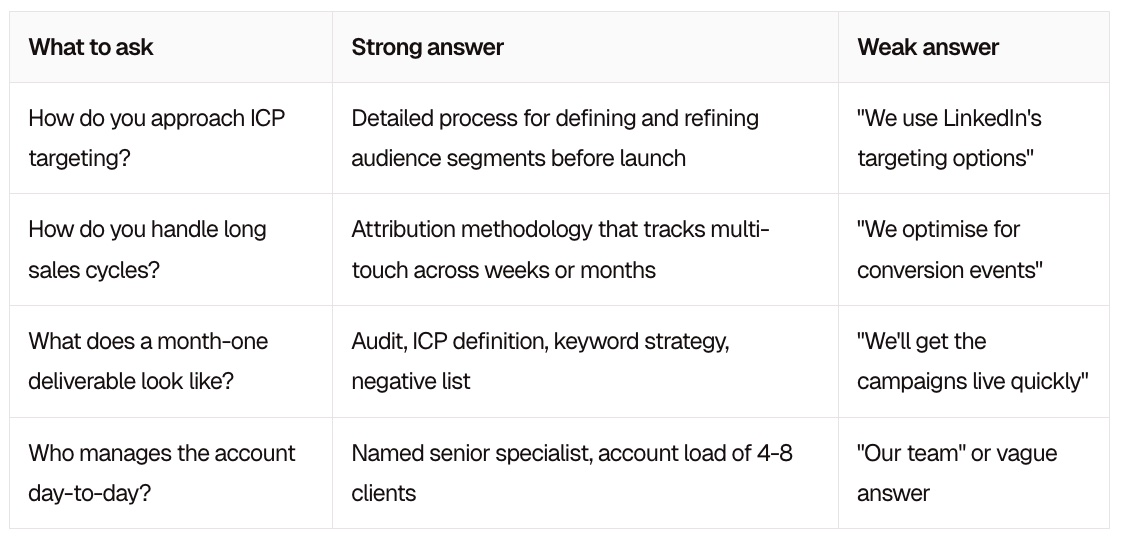
One practical test: ask any prospective agency for benchmark ranges for your specific sector. If they cannot provide them, or they quote generic industry averages without caveats, that is a signal. Good agencies have built up enough client data to know what performance looks like across different verticals, deal sizes, and funnel stages.
For context, here are the ranges a well-informed B2B PPC agency should be working within for UK-based campaigns in 2025:
These numbers matter less as absolute targets and more as a baseline for the conversation. An agency that cannot contextualise your performance against sector benchmarks is either inexperienced or not paying attention to your account.
The real benchmark question to ask: "What does a good MQL-to-SQL rate look like for a business at our deal size, and how does your reporting help us track it?" High-performing B2B marketing teams convert 10-30% of MQLs into sales-accepted leads. If your agency's reporting does not surface this metric, you have no way of knowing whether the leads they are generating are actually useful to your sales team.
Agency pricing models are not neutral. They create incentives, and those incentives shape behaviour. Understanding the model tells you a lot about how the relationship will play out.
There are three common structures:
"The pricing model matters less than whether the incentives it creates are aligned with your goals." The agency that wants the same things you want is the right agency, regardless of which model they use.
What to look for: an agency that can explain their model, acknowledge its incentive structure, and articulate why it works in your specific situation. Vagueness here is a red flag. So is an agency that pressures you into a long-term contract before demonstrating results. A confident agency does not need to lock you in.
Every PPC campaign has bad months. What separates a strong agency from a frustrating one is not whether performance dips; it is what happens when it does.
Ask any prospective agency this question directly: "What does a typical month look like when performance drops? Do you flag it proactively, or does it come up in the monthly call?"
The right answer involves proactive communication, a clear hypothesis about what caused the dip, and a documented plan to address it. The wrong answer is an agency that waits for you to notice, then explains the situation with platform-level excuses (algorithm changes, seasonality, increased competition) without offering a concrete response.
According to Clutch's agency research, communication and transparency are consistently the top factors clients cite when rating agency relationships highly. The capability gap between good and average agencies is smaller than most people assume. The accountability gap is much wider.
With the evaluation criteria clear, the process itself becomes more straightforward. A few structural recommendations:
Ask shortlisted agencies to audit your existing account before the formal pitch. How they approach the audit tells you more than any presentation. Look for: specific findings (not generic observations), prioritised recommendations tied to commercial outcomes, and evidence that they have actually looked at your data rather than recycled a template.
A confident agency will agree to a time-limited pilot. This protects you from a long commitment before trust is established and gives the agency a clear opportunity to demonstrate their approach. Any agency that refuses or heavily discounts the value of a pilot period is signalling something worth paying attention to.
Client reviews on Clutch are verified and structured. Look for patterns in what clients praise and what they criticise, not just the star rating. Agencies with consistent comments about communication, transparency, and proactive reporting are worth shortlisting. Agencies with consistent comments about account turnover and opaque reporting are not, regardless of their headline results.
If the answer to all six is yes, you are evaluating the right agency.
Most B2B PPC agencies are not bad at running ads. They are bad at connecting those ads to the commercial outcomes you actually care about. The selection process fails when it evaluates the wrong things: pitch quality, credentials, and price, rather than measurement rigour, B2B-specific experience, and accountability structures.
The framework above will not guarantee a perfect agency relationship. But it will significantly improve the odds of finding one that reports on what matters, understands your pipeline, and tells you when something is not working before you have to ask.
That is what good looks like.

Lever Digital is proud to be a 2026 UK Paid Media Awards finalist, recognised for outstanding performance-led paid media campaigns across B2B and SaaS.


.png)
